Home › Guides › Best Electric Scooter for Hills: What Actually Climbs
Best Electric Scooter for Hills: What Actually Climbs
Hills are the honest spec test. On flat ground every scooter looks adequate; on a 10% grade, motor wattage, battery voltage, and brake heat separate the machines that commute from the machines that walk. The short version: 800W-class motors handle most city grades, and sustained 15%-plus grades want dual motors or 2000W and up.
The grade math
Climbing multiplies current draw - a sustained 6% grade roughly doubles consumption versus flats, and steeper ramps it up from there. What you feel as "hill power" is torque headroom: watts determine how much climb the motor eats while still holding speed, and voltage (36V vs 48V vs 60V) determines how much current the system can push before the controller gives up. A 250-350W entry motor will climb a gentle overpass slowly and a real hill at walking pace; the 800-1000W class holds 12-15 mph up typical city grades with an adult aboard; 1500W and up treats hills as flat ground.
What to check on the spec sheet
- Nominal motor power, not peak. Listing pages love peak figures; the nominal number is what the motor sustains. Every model page here links to the official sheet - read the smaller number.
- Voltage: 48V is the floor for regular hill work, 60V+ is where performance climbers live - the KuKirin G4 Ultra pairs 1200W with a 60V pack for exactly this reason.
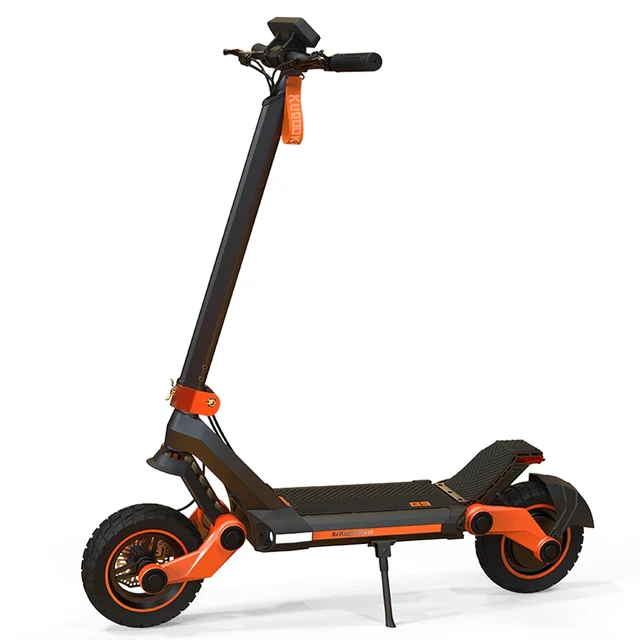
- Dual motors for steep towns: two motors double the traction and the torque. The KuKirin G3 dual-drive ($650, in the under-$1,000 catalog) is the budget entry into that club.
- Brakes for the ride down: descents are a heat problem - long downhill runs glaze small rotors and fade cable brakes. Discs, ideally large ones, are not optional in hill country.
- Pneumatic tires 10 inches and up: grip is the contract between your watts and the pavement; the tire guide explains why solid small wheels give hill riders the worst of both.
The catalog's hill natives
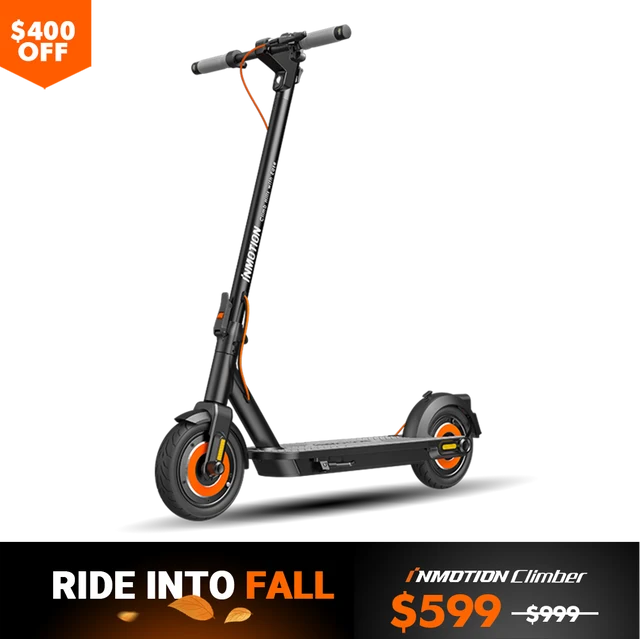
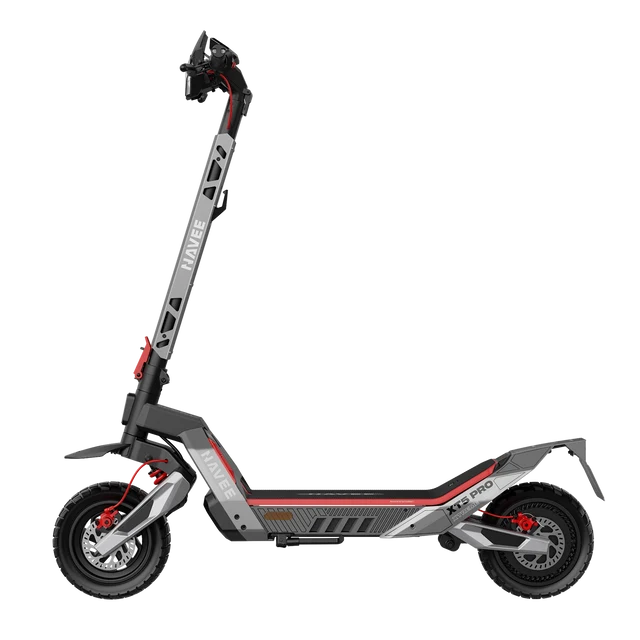
One model wears its specialty in its name: the Inmotion Climber ($599) puts a 1500W motor under a commuter price - the pattern-breaker of the current catalog. Above it, the NAVEE XT5 Pro (2200W) adds slope headroom for heavier riders - the heavy-rider checklist pairs naturally with hill specs. Below the 800W line, hills get slow and batteries get drained fast; budget riders in hilly cities should stretch one price tier rather than climb on an underpowered motor every day.
Hill-grade picks from the tracked catalog
Downhill discipline
The dangerous direction is down, not up. Long descents build heat in rotors and pads, and faded brakes at the bottom of a hill are a classic scooter crash. Pulse the brakes on long descents rather than dragging them, keep speed below what you can see to stop for, and weight the rear. Range recovers a little on descents through regenerative braking - treat it as a bonus, not a plan.
Bottom line: buy for your steepest daily grade, not your average one. The buying guide walks the rest of the checklist, and every model page links the official sheet where nominal watts and voltage are printed.
FAQ
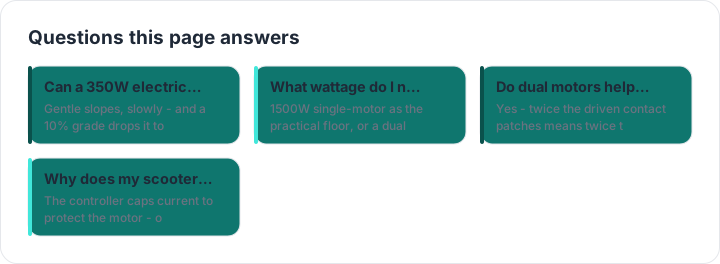
Can a 350W electric scooter climb hills?
Gentle slopes, slowly - and a 10% grade drops it to walking pace with an adult aboard while draining the battery fast. For regular hill commuting, start at the 800-1000W class.
What wattage do I need for 15% grades?
1500W single-motor as the practical floor, or a dual-motor setup - torque and traction both matter on grades that steep. Check nominal, not peak, wattage on the official spec sheet.
Do dual motors help on hills?
Yes - twice the driven contact patches means twice the traction and climbing torque, which matters most on wet or steep streets. The cost is price and weight, not range on flat ground.
Why does my scooter slow down uphill even at full battery?
The controller caps current to protect the motor - on a grade the demand exceeds the cap, so speed drops until draw and limit balance. It is normal behavior; more nominal watts raises the balance point.